

Last Updated: November 24, 2026
Quick Summary
To find streetwear with distinctive back prints, decide what kind of graphic you want first, then search by the artwork, placement and garment format together. Search for terms like full back print tee or oversized back graphic hoodie, and use visual search with a tightly cropped photo of the back. Judge each back print on its focal point, theme, and print scale before buying.
- Combine two search axes, such as heavyweight plus Japanese back print, to narrow results faster.
- Crop a back-print photo tightly and run it through Google Lens or marketplace image search.
- Sort marketplace listings by newly listed to catch fresh drops before they trend.
- Screen printing suits bold, high-contrast shapes, while DTG handles detailed full-colour artwork.
- Prefer cold-wash, hang-dry care instructions to keep back prints from fading or cracking.
Table of Contents
- How to Find Streetwear with Distinctive Back Prints: Where to Start
- Search Terms and Visual Search Techniques for Back-Print Designs
- Judging Whether a Back Print Is Distinctive: A Practical Checklist
- Print Types and Quality Signals to Check Before Buying
- Finding Independent Designers and Limited-Run Releases
- Fit, Blanks and Styling Around a Large Back Graphic
- Shop the Butterfly, Namakubi, Geisha Oni and Neon Tokyo Back-Print Tees
- Frequently Asked Questions
How to Find Streetwear with Distinctive Back Prints: Where to Start
Drippy Tee's Official has built its collection around one idea: a back print is often the first thing people notice. The easiest way to find streetwear with distinctive back prints is to know what to look for before you start scrolling.
Trend guidance for 2026 points in a clear direction. Oversized back prints paired with a simpler front are described as a current print direction, giving a tee "movement and presence" without crowding the chest (Streetwear Print Trends 2026 That Hit Hard).
Begin with a short list of the designs and styles you respond to. Then compare them against the pieces below, which show how the same idea plays out in different artwork.
- Pick a front that stays quiet and a back that carries the statement.
- Note the artwork themes you keep returning to, such as Japanese-inspired motifs or neon city imagery.
- Decide whether you want a tee or a hoodie, since the back graphic reads differently on each.
Search Terms and Visual Search Techniques for Back-Print Designs
Most guides stop at "search for back print tees." That returns a wall of front-facing product shots. To actually surface distinctive back prints, you need to search the way the garment is photographed and described by the people who make it.
Build queries around the graphic, not the garment
Keyword searches work best when you describe the artwork, the placement, and the garment format together. Try these patterns and swap the bracketed terms for your own taste:
- Placement-led: "full back print tee," "oversized back graphic hoodie," "large back print sweatshirt," "back print only tee."
- Style-led: "Japanese back print tee," "tattoo flash back print hoodie," "neon Tokyo back graphic," "archival illustration back print."
- Format-led: "heavyweight back print tee," "boxy fit back graphic tee," "garment-dyed back print hoodie."
- Rarity-led: "limited run back print tee," "small batch graphic hoodie," "artist collaboration back print."
Combine two axes at a time. "Heavyweight" plus "Japanese back print" narrows faster than either term alone, and it filters out thin fast-fashion listings that use the same keywords.
Use search operators and filters to cut noise
On Google, wrap a phrase in quotes to force an exact match ("full back print"), use site: to search a specific marketplace or brand domain, and add -front to push down listings that only show the chest. On marketplaces like Grailed, Depop, or Etsy, sort by "newly listed" rather than "relevance" to catch fresh drops before they trend, and use the size and condition filters to remove listings that will not fit or will not survive wear.
Make visual search work harder
Save a clean photo of the back of a garment you like, crop tightly to the graphic, and run it through Google Lens or a marketplace's image search. Crop out the model, the background, and any front view so the engine matches the artwork rather than the photo composition.
A common pattern is to run the same image through two engines, because they index different catalogs. One may surface the original artist's shop while the other surfaces resellers. When you find a match, note the artist name and search that name directly; small labels often publish back prints that never rank for generic keywords.
Watch out: reverse image search can return near-identical bootlegs alongside the original. Check the seller's other listings and the print method description before assuming you have found the source.
Read the listing the way a buyer would
Search results reflect how a design was photographed. Filter for listings that show a clear, straight-on back view, a close-up of the print texture, and a shot of the garment worn from behind. A listing with only front-facing photos tells you almost nothing about the back print's scale, placement, or linework. Save the listings that pass this photo test into a shortlist, then compare them against the checklist in the next section.
Judging Whether a Back Print Is Distinctive: A Practical Checklist
Not every large graphic stands out. Use this checklist to judge whether a back print is genuinely distinctive:
- The artwork has a clear focal point rather than a generic repeating pattern.
- The design uses a specific theme, such as a particular illustration style or cultural reference.
- The colors and linework are deliberate, not just a default logo placed on the back.
- The print scale suits the garment, so the design fills the back without looking stretched.
- You could describe the graphic to a friend and they would recognize it.
If a print passes most of these checks, it is more likely to set your outfit apart from the crowd.
Print Types and Quality Signals to Check Before Buying
Print method affects how a back graphic looks on day one and how it ages over a year. The listing rarely tells you everything, so treat the product page as evidence to be cross-checked rather than a claim to be trusted.
Match the method to the artwork
Screen printing lays down thick, opaque ink that holds bold, high-contrast shapes and flat color blocks. It suits large back prints with few colors, and a well-cured screen print survives many washes without fading.
For a large back print with detailed illustration, DTG and screen printing are the most common choices. A hybrid approach, where a screen-printed base is combined with DTG detail, is common in mid-tier streetwear and can offer both bold color and fine linework.
Inspect the photos for these signals
- Colors look solid and even, with no blotching, banding, or visible halftone dots where the design should be flat.
- Fine lines and small text are legible in close-up shots; if the listing has no close-up, ask the seller for one.
- The print edge is clean rather than feathered, which suggests the ink was applied and cured with control.
- The fabric under the print is visible in texture shots, so you can judge whether the print sits on top of the cloth or sinks into it.
- The listing names the print method and the blank brand rather than only saying "premium print."
Judge durability before you buy
A back print fails in predictable ways: cracking along fold lines, fading from UV and repeated washing, and peeling at the edges. Screen prints crack when the ink is too thick or under-cured; DTG prints fade when washed hot or tumble-dried. Look for care instructions on the listing and prefer cold-wash, hang-dry guidance.
Watch out: a soft hand-feel is not automatically a quality signal. Very soft DTG prints can be thin and fade quickly, while a slightly stiffer screen print may outlast it by years.
Check the return policy and ask the right questions
Before ordering, confirm the return window, whether worn or washed items are returnable, and who pays return shipping. Ask the seller for a straight-on back photo in daylight and a close-up of the print edge. A seller who answers with clear photos is usually a safer bet than one who only sends marketing images. Save the listing screenshots and the seller's replies; if the print arrives cracked or misaligned, that record makes a return or exchange far easier.
The article compares the main print methods and how each one holds up:
| Print method | Best for | Key difference |
|---|---|---|
| Screen printing | Bold, high-contrast shapes and flat colour blocks | Thick, opaque ink; survives many washes when well cured |
| Direct-to-garment (DTG) | Detailed, full-colour artwork and gradients | Soft hand-feel, but can fade faster with harsh washing |
| Embroidery | Smaller chest or sleeve marks | Raised texture; on a large back panel can pucker with poor backing |
| Hybrid (screen + DTG) | Bold colour with fine linework | Screen-printed base combined with DTG detail |
Finding Independent Designers and Limited-Run Releases
Some of the most distinctive back prints come from small, limited releases rather than mass catalogs. Look for independent labels that publish their design process, name their artists, and release pieces in short runs. Limited drops often mean the graphic will not show up on five other people, which matters if you want something that stands out.
Check how often a brand releases new artwork. Frequent, well-documented drops suggest a steady creative pipeline, while a catalog that repeats the same few graphics across many colors may offer less variety.
Fit, Blanks and Styling Around a Large Back Graphic
A large back graphic changes how a garment fits and how you style it. A heavyweight unisex tee gives the print a stable, structured surface, and its regular fit keeps the back graphic from looking distorted.
Styling works best when the rest of the outfit stays simple. Pair a bold back print with neutral bottoms and clean sneakers so the graphic remains the focal point. Wearing a tee with a large back design also means your outfit reads well from behind, which is worth considering on a busy street.
Shop the Butterfly, Namakubi, Geisha Oni and Neon Tokyo Back-Print Tees
If you want to see these principles in practice, start with the Drippy Tee's Butterfly Unisex Heavy Cotton Tee, which pairs a clean front print with a bold two-tone back design. The Namakubi Unisex Heavy Cotton Tee brings Japanese-inspired artwork to everyday wear, while the Geisha Oni Unisex Heavy Cotton Tee keeps the front subtle and puts the statement on the back.
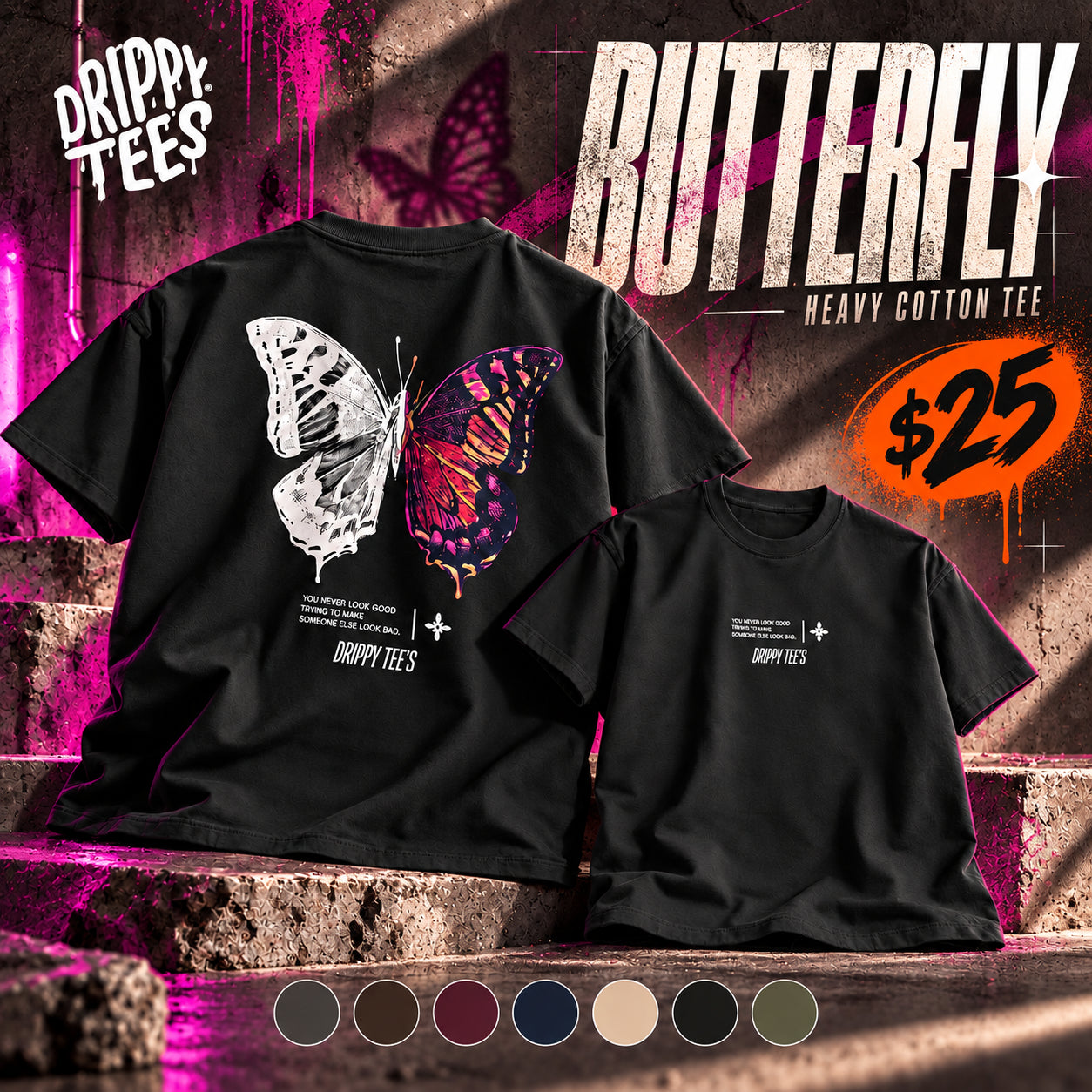
Each design shows a different way a back print can carry an outfit. Compare them against the checklist above, then choose the artwork that best matches your style.
Drippy Tee's Official offers bold graphic tees and hoodies built for people who want their back print to say something. Find the design that fits your style and make every outfit count.
Frequently Asked Questions
Where can I find unique streetwear?
Look for labels that show their own artwork and release in limited runs. Searching by a specific back-print style, such as a full-back illustration or a tattoo-art graphic, often surfaces designers you would not find through broad category searches. Drippy Tee's Official, for example, offers bold back-print tees such as the Butterfly and Neon Tokyo designs at $25 each, with sizes from S to 5XL.
How can I tell if a streetwear back print is high quality?
Check the print for sharp edges and even ink coverage. Ask whether the brand states the printing method.
What should I look for in a graphic tee with a back print?
Look for a back design that has a clear focal point and works as a complete composition rather than a filler image. A simple front paired with a larger back graphic, as on the Namakubi and Geisha Oni tees, lets the back carry the statement. Check the fabric weight, the neck label and the regular fit description so you know how the graphic will hang on your body. A distinctive print should still read as intentional when you see it in person, not only in product photos.
Are oversized back prints still popular in streetwear?
Choosing a bold back print works well when you want the graphic to be the main feature of the outfit.
